Project Summary
CBSAI is a multi-tenant SaaS ecosystem I designed and architected from the ground up. The platform brings together disparate business functions—finance, customer relationship management, human resources, payroll, vendor management, inventory, and analytics—into one integrated, scalable system.
The platform is built for businesses that need centralized visibility and control across their operations. It combines enterprise-grade architecture with AI-powered insights, role-based workflows, and secure multi-tenant isolation.
Business Problem
Most organizations struggle with fragmented systems. Finance data lives in one platform, CRM in another, HR in a third. This fragmentation creates:
- • Siloed data: Business leaders cannot see across departments
- • Manual workflows: Data entry and reconciliation are repetitive
- • Limited insights: AI and analytics are an afterthought, not central
- • Operational complexity: Managing multiple systems is expensive and error-prone
My Role
Founder & System Architect: I conceptualized CBSAI and designed the overall architecture, making key decisions about multi-tenancy, data isolation, security, and scalability.
Technical Project Manager: I led planning, roadmapping, stakeholder coordination, and delivery of major platform modules and features.
Full-Stack Developer: I designed and implemented core backend systems, REST APIs, frontend dashboards, authentication, authorization, and business logic.
Architecture & Technical Approach
Multi-Tenant SaaS Architecture
CBSAI is built on a multi-tenant architecture that allows businesses to share infrastructure while maintaining complete data isolation. Each tenant's data is isolated at the database level with workspace-based partitioning.
Tech Stack
- Frontend: React with modern UI patterns, responsive design, and real-time data binding
- Backend: Node.js with Express.js for scalable, maintainable API development
- Database: PostgreSQL with careful schema design for multi-tenancy, data integrity, and complex queries
- Authentication: Secure JWT-based authentication with role-based access control (RBAC)
- AI Integration: Pluggable AI workflows for analysis, recommendations, and automation
Key Design Decisions
- Modular architecture: Each business function (Finance, CRM, HR, etc.) is a self-contained module
- Workspace isolation: Separate workspaces allow teams to organize and manage their own data
- Role-based permissions: Fine-grained permission model supports complex organizational structures
- API-first design: All functionality is available through secure REST APIs for flexibility
- AI-powered insights: AI workflows are central to the platform, not bolted on
Platform Overview
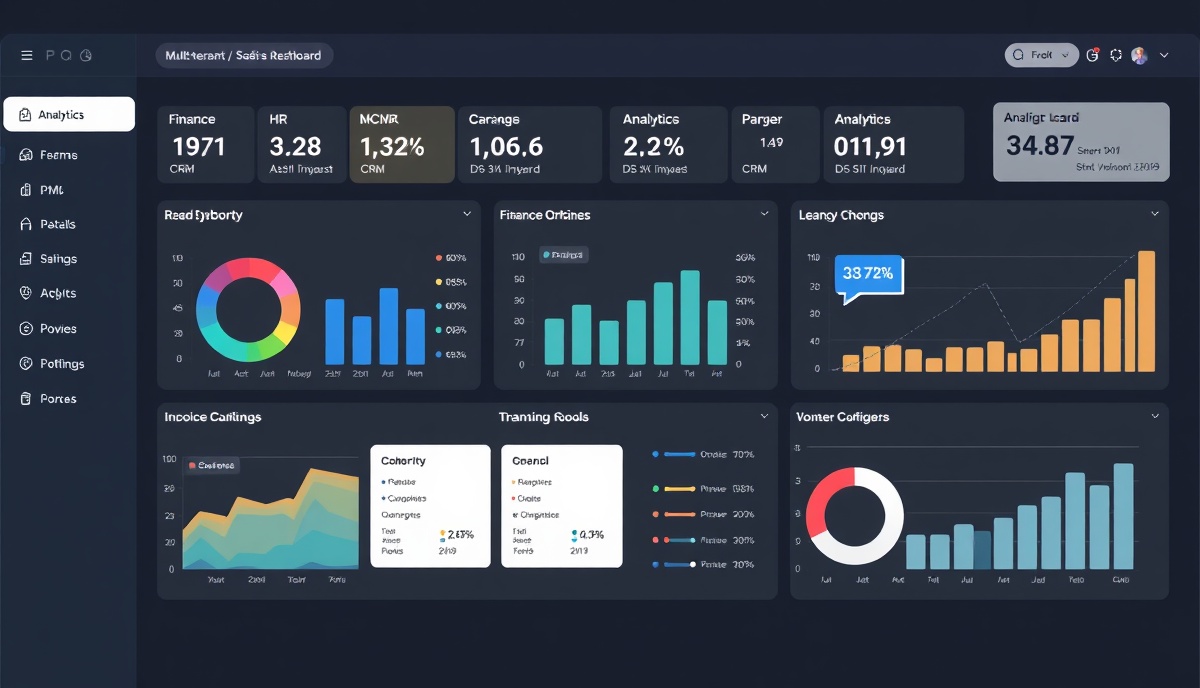
The CBSAI ecosystem unifies multiple business functions into one cohesive platform, with real-time data visibility, cross-module insights, and AI-powered recommendations.
Key Features & Modules
Finance Module
Comprehensive financial tracking, reporting, KPI analysis, client grading, and AI-powered business intelligence
CRM Platform
Accounts, contacts, deals, activities, pipeline management, marketing attribution, and AI recommendations
HR & Payroll
Employee records, payroll processing, PTO management, W-2 planning, policy controls, and workflow automation
Vendor & Inventory
Vendor management, purchase orders, inventory tracking, and integration with finance workflows
Analytics Dashboard
Cross-module analytics, KPI visualization, trend analysis, and customizable reporting
AI Workflows
AI-assisted analysis, intelligent recommendations, automation triggers, and business intelligence
Challenges Solved
Multi-Tenant Data Isolation
Implementing secure, performant data isolation at the database level while allowing shared infrastructure required careful schema design, row-level security policies, and isolation verification.
Complex Permission Models
Supporting role-based access control across multiple modules with granular permissions required designing a flexible, maintainable permission system that could scale across the platform.
Cross-Module Data Integration
Allowing modules to communicate and share data securely while maintaining isolation required careful API design and middleware patterns for safe, auditable data flow.
AI Workflow Integration
Integrating AI assistants into business workflows required designing systems that are fast, reliable, auditable, and focused on real business value rather than AI novelty.
Business Value
Unified operations: CBSAI eliminates system fragmentation. Finance, CRM, HR, and operations teams can all see across the business and work from a single source of truth.
Automated workflows: Manual processes are reduced through integrated workflows and AI-powered automation, freeing teams to focus on strategy and growth.
Data-driven decisions: AI-powered insights and real-time analytics help business leaders make faster, better-informed decisions across all functions.
Scalable infrastructure: The multi-tenant architecture means that as the business grows, the platform grows with it. There's no need to re-implement or migrate to a new system.
Reduced complexity: One integrated platform reduces licensing costs, training burden, and operational overhead compared to managing multiple disparate systems.
Interested in discussing SaaS architecture, system design, or project leadership?
Get in Touch